A Family Chronicle
The Family Portrait Above the Piano
An essay on how, using deep AI research, I found my family roots stretching back 170 years
My genealogical investigation began long before I realised I was doing genealogy.
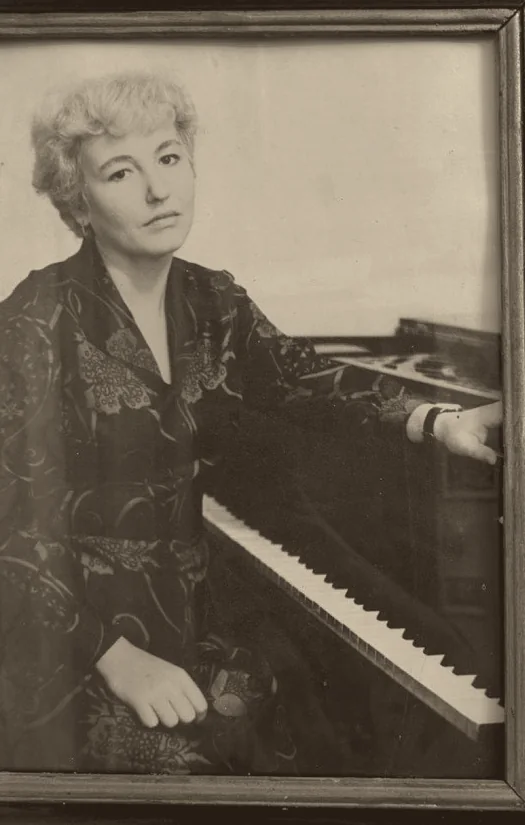
My grandmother was called Anna Yevgenyevna Sladkovskaya, née Vestner.
She stood completely apart from all my relatives, and from the ordinary residents of the beautiful Taganrog I loved so much. Even in appearance there was something about her from another time. She resembled an actress of pre-revolutionary cinema, or a woman from a portrait of the early twentieth century: stately, of noble bearing, fair-haired, with a very unusual face that never seemed entirely Russian to me. Even her speech was a little unusual — with a barely perceptible intonation that sometimes sounded like a non-Russian accent, quite unlike the local southern dialect.
I knew her for as long as I can remember myself. My parents met and married in Taganrog, I was born soon after, and so Taganrog became, from the very beginning, one of the most important cities of my life.
Grandmother Anya was a pianist and a notable figure in the cultural life of her city. It was she who taught me to listen to music, who took me to concerts and museums. Even when we met in my own city, Petersburg, she would take me to the Hermitage and show me painting and sculpture as though continuing a conversation begun many years earlier in Taganrog.
Our conversations were rarely about everyday things at all. We spoke of art, of honour, of conscience, of the human person, of love. For a child, and later a teenager, this was a rather unusual way of talking with one’s grandmother.
Beside her I never felt that simple domestic freedom I had, for instance, with my grandmother on my mother’s side. Rather, I felt as though I were beside a form mistress from an old gymnasium. She set the conversation at a certain height and seemed to assume that her interlocutor was obliged to reach up to it. She made me listen to Chopin and Schubert, read books, and dine strictly on schedule.
She was, in general, a person not easily fathomed to the end. In her were joined beauty, cultural refinement, exactingness, a certain inner distance — and, with all that, the ability to influence other people very deeply.
Looking back now, I understand that her role in our family was far greater than it seemed to me then. She was one of those people through whom culture is passed on — not as a set of facts or good manners, but as the conviction that music, painting, history, love and the human person are serious things, worthy of thought.
The year 2026 marks ten years since she left us. That is why this account is most rightly dedicated to Anna Yevgenyevna Sladkovskaya, née Vestner.
Chapter I
The House in Taganrog
The magical aura around Grandmother Anya was not created by her alone. An enormous part was played by the house in which she lived.
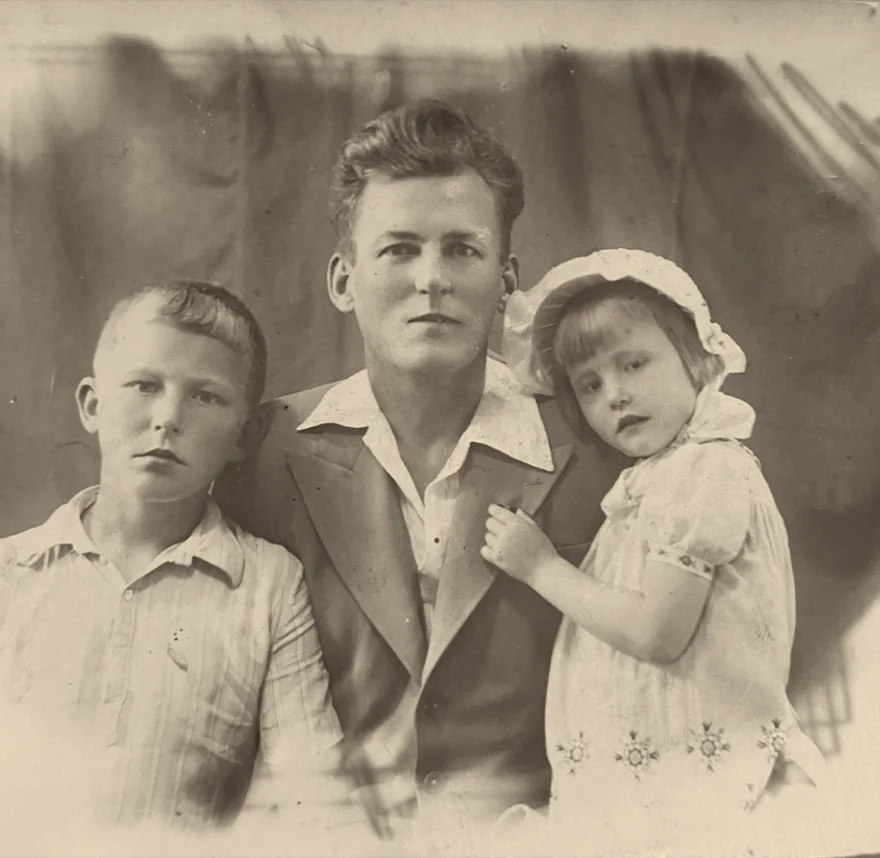
For me it was always precisely her house, although in fact it had belonged to her parents — Yevgeny Vladimirovich Vestner and Dora Valentinovna Vestner. I knew them both when I was very small. From that time only separate flashes of memory remain. I even remember the voice of my great-grandfather — grandfather Zhenya, whom for some reason everyone in the family simply called “grandfather Vestner”.
The house itself stood deep within a beautiful plot in the historic centre of Taganrog and was divided into two independent halves. Around the house lay an old orchard. Pears, plums, raspberries and grapes grew there. The garden was a little wild. Probably that is exactly why it seemed so interesting to a child.
In the yard stood a shed with grandfather Vestner’s workshop, with a deep cellar running under the house, and a garage.
Grandfather was always making something there, repairing, tinkering. After his death the workshop went on living for many years: my grandfather Misha worked there, and later his sons.
In the house itself, in the yard and in the shed, the past was everywhere.
I remember an enormous extending oak table. A Gothic sideboard. An old clock — also utterly Gothic, gloomy and beautiful, with a magnificent chime. Figurines, old books and even toys. Sometimes my grandmother would take out pre-revolutionary editions, books about the creation of the world, for instance, printed in such a typeface and written in such a language that a child could make out almost nothing in them.
And, of course, the photographs.
They hung on the walls, lay in albums, appeared out of cupboards and drawers. My grandmother showed me people long dead and told me who was related to whom.
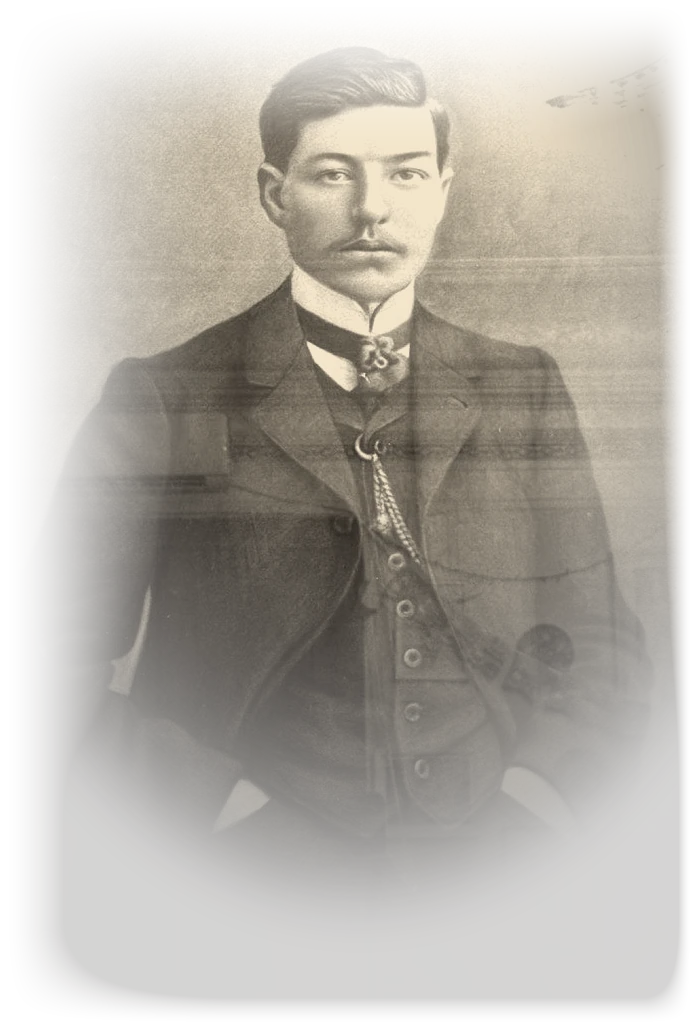
The most mysterious of the ancestors remained Vladimir Yulyevich Vestner. His enormous portrait, about a metre high, always hung above the piano.
It showed a very handsome and very sad man. For some reason I would now compare him with Doctor Watson from Conan Doyle’s world: a three-piece suit, a high stand-up collar, a tie, the massive chain of a waistcoat watch — and astonishingly sorrowful eyes.
A mysterious family legend surrounded him.
I knew that the Vestners were Germans. Later I heard a refinement from my father: probably Austrian subjects. Vladimir’s father was called Yuly — or, as the name sounded in my childhood imagination, Julius Vestner.
For some reason I liked that combination enormously. I already knew who Julius Caesar was, and the name Julius seemed to me a name out of some great, old and beautiful world.
Vladimir himself died tragically before the revolution, when his son, my great-grandfather Yevgeny, was not yet a year old.
According to family tradition, he was shot by a drunken Cossack officer. Where exactly it happened — in a restaurant, a hotel or some other establishment — the accounts diverged a little over time. The officers were said to have started a brawl and begun firing almost without aiming. One of the bullets ended Vladimir’s life.
At the time I could not, of course, have known that many years later I would find a newspaper account of his death — in almost the same details in which my grandmother had told the story.
My grandmother showed me an old photograph from which an artist had once made that enormous portrait. In the family it was said that the artist had been staying with relatives and had drawn it in pencil in barely a single night, with such precision that from a distance the drawing was hard to tell from an enlarged photograph.
I was very small when I first heard this story and studied Vladimir’s face. His face was imprinted very firmly on my childhood memories, and to this day, when I come to that house, I greet grandfather Vladimir in that portrait.
It was probably then that this man, who had died many decades before my birth, first became part of my own biography. I knew nothing of parish registers, nothing of address directories, nothing of the archives of the Russian or the Austrian Empire.
I had only the portrait, a few old objects and my grandmother’s story. But, as it turned out, that is already a great deal.
Chapter II
The Object from the Portrait
Grandmother Anya’s house remained for me forever homely, fairy-tale and museum-like all at once. The striking clock, the Notre-Dame sideboard, the family portraits. The Austrian grandfather Julius appeared to me as Drosselmeyer. My father a conductor, my grandfather a clarinettist, my grandmother a pianist. Ancient relics, musical instruments.
The most astonishing thing was that for those who lived there, no museum existed at all, of course.
It was the ordinary life of the late twentieth century. The children had skateboards and game consoles, there were tape recorders and video recorders in the house, entirely modern things were discussed — and alongside all that, every day people opened an antique sideboard, ate with ancient silver forks and knives, sat at an enormous oak table, took pre-revolutionary books from the shelves and used objects that were about a hundred years old.
What today would inevitably end up under glass or be declared a family relic was then simply furniture, a clock, books — household objects.
And probably that is exactly why the past was felt so strongly.
It was not exhibited.
People simply lived inside it.
By the age of ten or twelve I had assembled a small stock of information about the Vestners.
Somewhere there was Austria.
At some point the ancestors had come from there.
There was the mysterious Yuly — a well-known and, according to family memory, fairly prosperous master craftsman from Novocherkassk.
There was his son Vladimir, who died in tragic circumstances.
There was his enormous portrait above the piano. And grandfather Zhenya, much older than his father in the portrait, looked out sternly from his own picture with a square chin and a thin hawk-like nose that was passed on to my father.
When exactly did the ancestors come to Russia? From where? Under Catherine the Great? In the nineteenth century?
No one knew.
I even began to treat the story with a certain irony. Family legends are convenient precisely because they cannot be verified.
As it turned out later, I was badly mistaken.
About twenty years passed.
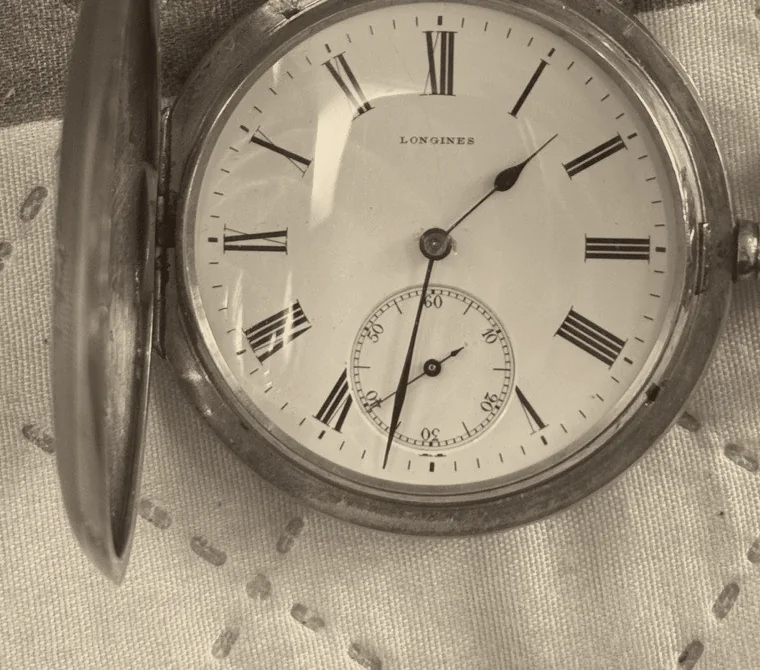
I was a little over thirty when one day my father brought me a gold pocket watch on a chain as a birthday present.
My father has collected watches for a long time and over the years has given me splendid examples of the most famous makes. So in itself such a present was nothing unusual.
But this watch was different.
A gold Longines on a massive chain.
— This is grandfather Vladimir’s watch. That very one.
My ancestor from the portrait above the piano.
At that moment the family legend ceased, for the first time, to be only a story.
I was holding in my hands an object worn by a man who had died before the revolution.
I took the watch to a watchmaker. He opened the case, showed me how to wind it and set the time, examined the movement and said it was in surprisingly good condition.
On the case and the movement there survived numbers, hallmarks and inscriptions, including a reference to the Paris Exposition of 1900 and the Grand Prix of which the Longines firm was proud.
I wound the movement and listened to the watch still running more than a hundred years later.
But even then no investigation began. I simply knew that I now had an object from the portrait.
And again several years passed.
Chapter III
The Search
I had children of my own. My daughter grew up and entered university. My son started second grade.
I went on returning to Taganrog almost every year.
And in the summer of 2026 I found myself once again in Budapest on business, and from there travelled for two days to Vienna.
Both Vienna and Budapest made an enormous impression on me.
It was probably there that, after many years, the old family phrase surfaced again:
“The Vestners came from Austria.”
Once the word “Austria” had stood for almost nothing to me. It was as mythological a place as “before the revolution” or “under the tsarist regime”.
Now, though, I was walking through the real Vienna and suddenly thought that the people of my family legend might once have lived inside this world.
By that time I was already using new tools constantly in my own work — artificial intelligence, the analysis of large bodies of information, deep search.
And a simple thought occurred to me.
Why not try?
There was not much to start from.
Vestner. Yuly. Vladimir Yulyevich. Novocherkassk.
I began to search.
And almost at once two old postcards appeared. On them a name could be read:
Yekaterina Yulyevna Vestner.
And an address:
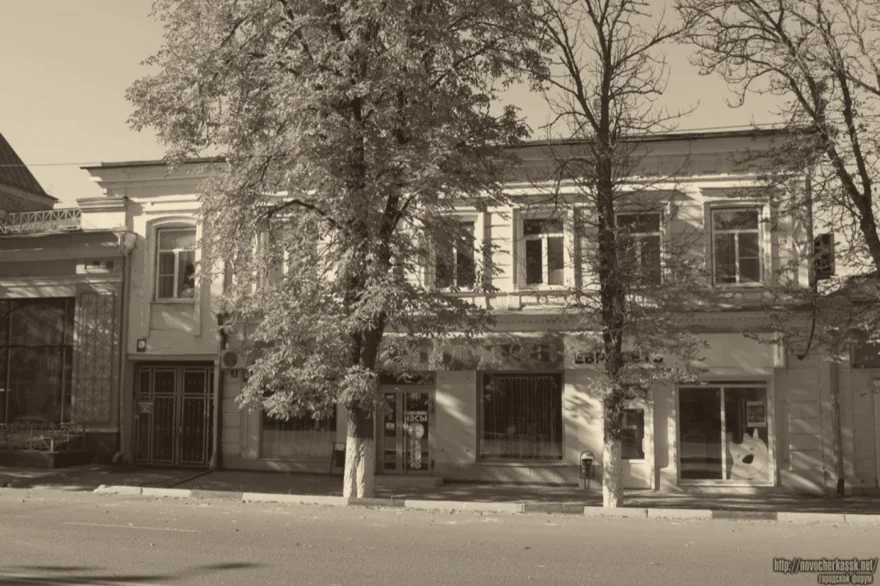
Novocherkassk. Moskovskaya Street, house 3.
Yulyevna. Vestner. Novocherkassk.
Before me was the first document in which several details of the family story converged at once.
The street existed.
The house existed.
Then a mention of Yekaterina Vestner turned up in the records of the Novocherkassk girls’ gymnasium of the early twentieth century.
They had an address.
They had a school.
They had a real city they had walked through.
And that was when I understood that I would no longer be able to stop.
Chapter IV
The Family Comes Out of the Fog
I had never thought that genealogical research could absorb me so completely.
Probably it was not even about genealogy.
What I liked was the detective story.
I felt like something between a researcher, a forensic investigator and a private detective.
One fact caught on to the next.
One of the first major discoveries was Alexander Yulyevich Vestner.
He was born in 1886 — exactly a hundred years before me — and was Vladimir’s brother.
I managed to find his name in materials connected with the White movement. After the revolution Alexander ended up in emigration and then moved to the United States, to New Jersey.
In America his family continued.
After a few clicks on the internet I was suddenly looking at the pages of people who were descendants of a man born in the reign of Alexander III.
I found the American branch, found a relative who had served in Vietnam, found his son Alex Vestner — a well-known American photographer.
But something else occupied me most of all: understanding Yuly’s own family.
And here the surname began to appear again and again.
Grigory Yulyevich Vestner — the First World War, a hospital, 1915.
Alexander Nikolayevich Vestner, called up from Novocherkassk to the front and awarded the medal “For Battle Merit” in 1942. On one of the postcards an “Uncle Kolya” appeared writing to “Aunt Katya”, which suggested a possible link to Nikolai Yulyevich Vestner.
Other Vestners from Novocherkassk and its surroundings.
Yekaterina Yulyevna, meanwhile, remained almost a ghost. I knew her name, saw the address, saw the trace in the gymnasium — and then she vanished. Women are especially hard to find in genealogy in general: after marriage the surname changes, and the person seems to dissolve in the archive.
But the main discovery came soon afterwards.
Chapter V
The Murder of Vladimir
Two newspaper reports from March 1911 came to light. They described an incident at the Novocherkassk hotel “Bolshaya Moskovskaya”.
Three carousing Cossack officers started a brawl. Shooting broke out. A young merchant by the name of Vestner was killed.
I reread the report several times.
It was the story I had heard from Grandmother Anya as a child.
Drunken officers.
A scandal.
Shooting.
The young Vestner.
Pre-revolutionary Novocherkassk.
In more than a hundred years the family story had scarcely changed.
The newspaper added details.
And the young Vestner was downstairs at that moment, where they were playing billiards.
At first the billiards seemed to me merely a vivid detail of a newspaper report.
Later it turned out that it too had not appeared there by chance.
Here it is worth picturing Novocherkassk of that time.
It was the capital of the Don Cossack Host — a city of officers, officials, merchants and prosperous Cossacks, with the ataman’s palace, a cathedral, hotels, restaurants and billiard rooms. For a good craftsman working with carriages, metal and expensive objects, the city was a thoroughly suitable market.
Moskovskaya Street was one of the central ones.
In other words, the Vestners were not somewhere on the outskirts of some random town. They lived and worked literally inside the very milieu that could be their clientele.
I got in touch with Anastasia, a guide and researcher of the history of Novocherkassk. I told her the whole story.
She gave me one more important detail: the hotel “Bolshaya Moskovskaya” stood at Moskovskaya 1 (while the Vestner house was at Moskovskaya 3).
And it was from her that I first learned what the family did for a living.
The Vestners’ locksmith and carriage workshops were located there. (Article by Anastasia Tretyakova https://rusdeutsch.ru/Nachrichten/16511?ysclid=mtejbciqq428244355)
What is more, the house has survived.
Today there is a café in it. During renovation an old wall was opened up there and objects were found that had been left by the former owners and their workshops.
Anastasia gave me the contact of the people from the café.
I wrote to them.
And soon they sent me photographs of the objects taken out of the wall of the house where, more than a hundred years ago, my ancestors had lived and worked.
Here the story took on an almost literal meaning.
In my childhood Vladimir’s portrait hung on the wall of one family house.
Forty years later another wall, now in Novocherkassk, was opened up — and it began of its own accord to give back traces of the Vestners’ former life.
In other documents a name was found as well:
Vestner Yuly Samoilov.
Until then Yuly had seemed to appear out of thin air.
Now, for the first time, he had a father.
Chapter VI
Inside the Wall
Among the things from the old wall were nails, fragments of bottles, pieces of packing cloth, a postal tag with a Novocherkassk stamp of 1906.
And a large scrap of sackcloth with an inscription in a fine old hand:
“Valuable, for the tenth jubilee, to Mr Yu. Vestner from V. Hartmann of Łódź. Novocherkassk, Moskovskaya.”
We puzzled over this phrase for quite a long time.
If the objects really do belong to a single parcel or a single period, it could have been sent around 1906.
But what sort of “tenth jubilee”?
At the time I had no answer.
For the moment something else mattered more: a man named Hartmann was sending a valuable parcel from Łódź to Yuly Vestner in Novocherkassk.
Yuly had connections hundreds of kilometres from home.
And then came another almost mystical episode.
On one of the old postcards found on the internet, addressed to Yekaterina Vestner, a note had been added in ballpoint pen over the old text many decades later (I attached the photograph of this card above).
I knew that handwriting.
I have kept a great many photographs of drawings and postcards by my great-grandfather Yevgeny Vestner.
The same hand.
The same manner of writing.
It turned out that the postcard I found digitised on the internet a hundred years later had once been in the hands of a man whose voice I myself still remembered.
It was precisely such moments that made up the chief thrill of the investigation.
First people acquire names.
Then addresses.
Then documents.
Then a house.
Then workshops.
And then suddenly — a familiar hand.
Odessa
Now I had the name of Yuly’s father: Samuil.
And I began to look for other Vestners of the Russian Empire.
The search led to Odessa.
Practically in the very centre of the city there was the workshop of A. S. Vestner.
Its advertisements turned up in the pre-revolutionary press.
The owner was called Alexander Vestner.
He was an Austrian subject.
And his middle initial — S.
A single initial, of course, proves nothing in itself.
But I already had a Yuly Samuilovich.
Further on it became even more interesting.
Alexander Vestner’s Odessa workshop dealt in billiard tables.
In another advertisement it promoted technical equipment and represented an Austrian manufacturer.
In other words, this was a serious craft and engineering enterprise.
And what did we know about the Vestners in Novocherkassk?
Locksmithing.
Turnery.
Carriage making.
And — billiards.
I told Uncle Zhenya about this, the grandson of grandfather Vestner.
He remembered that the family had kept large tumblers made of a material believed to be waste from working ivory in the manufacture of billiard balls.
For billiard production ivory was the most important material, so alongside the information already found this family detail looked intriguing.
And then Vladimir appeared again.
He was killed during a game of billiards.
According to family lore, he was himself an excellent player.
And billiards gradually ceased to look like a chance detail.
So a hypothesis arose:
what if Alexander of Odessa and Yuly of Novocherkassk were brothers?
Alexander — an Austrian subject.
Yuly — the son of Samuil.
Alexander — the initial S.
Yuly — the patronymic Samoilov (Samuilovich in the older form).
The period, the origin, the craft and the family’s technical culture all matched.
I try to be careful with beautiful coincidences. In genealogy it is far too easy to fall in love with one’s own version and start bending the facts to fit it. But the hypothesis kept growing stronger.
If Alexander and Yuly really were brothers, their father had to exist somewhere.
A man named Samuil Vestner.
Chapter VII
Samuil
The most interesting part began when I started looking for Samuil.
I went through the Samuils one after another.
The first — not him.
The second — not him.
At the third I stopped.
Before me was Samuil Vestner of Pest.
He had several children.
And among the sons:
And:
Julius. 1856.
I simply stared at the screen.
Alexander.
Yuly.
The very two names that had already turned up, entirely independently, in Odessa and Novocherkassk.
And now the father had “appeared”.
Samuil.
And the city.
Pest.
Then still a separate city of the Austrian Empire, which later, together with Buda and Óbuda, would become Budapest.
But that was not even the main thing.
The church records gave Samuil’s profession.
Today the word sounds almost like a fairy tale, but in the middle of the nineteenth century it was a thoroughly serious urban craft. Gilders worked on frames, furniture, shop signs, decorative elements of interiors, carriages. The work demanded precision, a good eye, a steady hand and the ability to handle expensive materials.
I began to search for Samuil now as a specific craftsman.
And entries appeared.
First — a gilder.
Later — a master connected with carriage making.
And that was when everything began to fall together far more logically.
Samuil in Pest — a gilder.
Alexander in Odessa — owner of a turning and metal workshop and a maker of billiard tables.
Yuly in Novocherkassk — locksmith, turning and carriage workshops.
The craft seemed to pass through generations and cities.
And the dates fell into place.
Alexander was born in 1839.
In 1869, at the age of thirty, he opens his own workshop in Odessa and marries.
Yuly was born in 1856.
And then I remembered the sackcloth from the wall.
“For the tenth jubilee, to Mr Yu. Vestner…”
Beside it — the postal stamp of 1906.
1856.
1906.
Fifty years.
If these two finds really do belong to a single parcel, a very beautiful and plausible version emerges: the mysterious “tenth jubilee” could have meant Yuly’s fiftieth birthday.
For now it is precisely a version.
But the dates match perfectly.
And thirty years after Yuly’s birth, in 1886, Alexander Yulyevich is born in Novocherkassk.
Later — Vladimir Yulyevich.
That very Vladimir from the portrait.
That very man whose gold watch is now kept by me.
Now I know a great deal more about the world they came from.
Pest
And so the family’s place of origin acquired real outlines for the first time.
Not an abstract “Austria”.
Pest.
For me this had an entirely special meaning.
I had been to Budapest several times already. I had walked through its centre with my children and friends, had passed many times literally beside places that now suddenly became part of my history.
From the church records it was possible to establish the community in which Samuil’s children were baptised: the German Evangelical congregation of Pest in the area of today’s Deák Square.
Not far away lay the quarters where Samuil lived and worked.
Now I could do more than pronounce my ancestor’s name.
I could picture, approximately, his route through the city.
For me there is one more entirely unnecessary but beautiful rhyme in this.
The Budapest Opera House would later appear nearby.
Several generations on, a descendant of this family would be my father — Alexander Sladkovsky, a symphonic conductor who has performed in that Opera House more than once.
Such coincidences prove nothing.
But it is precisely they that create a personal sense of history.
A similar geography repeats itself further on.
Alexander Vestner chooses the centre of Odessa — Langeronovskaya Street.
Yuly the centre of Novocherkassk, Moskovskaya Street, right beside the most important buildings of the Don capital.
And the family’s business logic becomes fairly clear.
Gilding.
Carriages.
Complex turning work.
Billiard tables.
These are goods and services for a prosperous urban public.
By all appearances, the Vestners knew how to do more than work with their hands.
They understood where their client was.
Chapter VIII
History Passes Through the Family
The further I went with the investigation, the less improbable the whole story seemed.
On the contrary.
It fitted the logic of the nineteenth century better and better.
A German-speaking family of skilled craftsmen from Pest. Sons growing up. A good trade. Connections. Capital.
And alongside — the rapidly growing south of the Russian Empire.
In the second half of the nineteenth century Odessa, Taganrog, Rostov, Mariupol and other southern cities were becoming an enormous space of trade, industry and new capital. Ports, railways and factories were built here, workshops and offices opened. Foreign entrepreneurs, engineers and skilled craftsmen came here.
In my native Mariupol, too, large industry was created with the direct participation of foreign capital. In Taganrog foreign merchant and entrepreneurial families were an ordinary part of city life. Of Odessa, with its multilingual commercial culture, there is no need to speak at all.
That is why what sounded in the family legend like an exotic migration “from Austria to Novocherkassk” looked, in the economic geography of the nineteenth century, like an almost natural movement in the wake of the market.
If my hypothesis about Samuil’s sons is finally confirmed, it will be a very intelligible story.
One son chooses Odessa.
The other the wealthy capital of the Don Cossacks.
Both arrive with a craft that can be sold well to a prosperous public.
And it is precisely here that one sees especially clearly how great history leaves its imprint on the fate of a single family.
First — the growth of cities, new markets, workshops, carriages, billiard tables and gilding.
Then — wars, revolutions, emigration, exile.
History leaves different marks on a family.
Sometimes it cuts them with a lathe tool.
Sometimes it covers them with gold leaf.
Sometimes with a boot.
Chapter IX
The Return
The fate of my great-grandfather Yevgeny Vladimirovich Vestner, despite everything he lived through, turned out, I think, to be a happy one after all.
His father Vladimir died when his son was still an infant.
But Yevgeny grew up, received an education, graduated from the Novocherkassk Polytechnic Institute and became an engineer. Already in the early 1930s he was working at the Taganrog aviation research institute.
In 1937 Yevgeny and his family were subjected to repression as the family of a German and sent into exile in the Altai.
Frightening as it sounds, it may be that this very exile paradoxically helped the family survive the war.
In the Altai life was poor and hungry.
But they stayed alive.
And two days before Victory a girl was born there.
Anna Yevgenyevna Vestner.
That very Grandmother Anya with whom this story begins.
After the war the family returned to the south, to Taganrog — the native city of Yevgeny’s wife, Dora Valentinovna.
The history of Dora’s family is a separate investigation, one still ahead of me. Her father was a fairly prosperous man even before Soviet times and managed to provide his daughters with houses.
One of them became that very house.
The house with the garden.
With pears and plums.
With raspberries and grapes.
With the workshop in the yard.
With the Gothic sideboard.
With the antique clock.
With the pre-revolutionary books.
With the piano.
And with Vladimir’s portrait above it.
An astonishing thing emerges.
As a child I perceived that house as the beginning of the story.
Now I understand that it was its continuation.
Yevgeny Vestner lived more than eighty years.
He worked as an engineer and was connected with the aviation world of Taganrog — a city with an enormous engineering history, out of which grew, among other things, the famous Soviet school of seaplane design.
Yevgeny and Dora had two children — Anna and Arnold.
Arnold left for Moscow.
Anna had three sons.
The eldest was named Alexander — my father.
The middle one Yevgeny, after grandfather Zhenya.
The youngest Mikhail.
And I like watching how names travel through the generations.
My children too bear the family names Alexander and Yekaterina — literally the same as the children of grandfather Yuly.
But names go on living even when their original meaning has long been forgotten.
All three of Anna Yevgenyevna’s sons grew into very talented people. But in each of them there is something I now want to call familial: independence, talent, leadership, the impossibility of being entirely ordinary.
And here another strange rhyme arises.
Samuil Vestner was a master craftsman.
His sons, if my reconstruction is right, were master craftsmen.
In Novocherkassk there were the Vestner workshops.
Yevgeny Vestner was constantly making something with his hands in the workshop in the yard.
After him his son-in-law and his sons worked there.
No one deliberately preserved any “dynastic tradition”.
For some reason it simply did not disappear.
Their descendants, too, are masters of their trade.
Chapter X
What Comes Next
My investigation lasted a little over two weeks.
And it is by no means finished.
I want to find the parents of Samuil Vestner and understand where he himself came to Pest from.
I want to find the record of his marriage.
I want to prove or disprove once and for all the kinship of Yuly of Novocherkassk and Alexander of Odessa.
I want to travel to Novocherkassk, walk into the house at Moskovskaya 3 and see with my own eyes the rooms where the Vestners lived and worked.
I want to learn the fate of Yekaterina Yulyevna.
I want to look for descendants of the Odessa branch.
And I am terribly curious to find out whether any Vestners have remained in present-day Budapest.
Perhaps part of my reconstruction will turn out to be mistaken.
Perhaps some beautiful bridge will have to be pulled down.
And that is normal.
In this investigation I constantly try to separate three things: what the family told, what is confirmed by documents, and what for now remains my hypothesis.
It is the last of these, I think, that matters most.
Because one wants to confirm a good family myth.
But a good investigation must be ready to refute it.
I have already contacted people who have been gathering information about the Vestners for many years, and I hope the documents will either confirm my hypothesis or force me to build another one.
But even if tomorrow it turns out that Alexander of Odessa and Yuly of Novocherkassk were not brothers, the main result of this research can no longer be undone.
Because in those two weeks something far greater happened to me than the compiling of a family tree.
For the first time I saw family history not as a set of stories told by older relatives, but as a space in which one can move.
Here is Pest in the middle of the nineteenth century.
Here is Samuil Vestner, gilder.
Here are his children.
Here is Odessa.
Here is Novocherkassk.
Here is Moskovskaya Street.
Here is the hotel “Bolshaya Moskovskaya”.
Here the young Vladimir is playing billiards.
Here is the shot.
Here is his little son Zhenya.
Here is the Altai.
Here is the girl Anya, born two days before Victory.
Here is Taganrog.
Here is the old house.
Here is the piano.
And above it hangs the portrait.
And here am I as a little boy.
And now my son and the new generation of our descendants.
The most unexpected result of the investigation, for me, was Budapest.
I have been there many times and for some reason have always loved that city.
Happy days of my adult life were spent there. There I worked, walked, met people close to me. There I met my father.
And it never occurred to me that a century and a half before us our ancestors might have walked those streets.
Now I have a new point on the map.
Not a tourist one.
My own.
Perhaps that is why genealogy unexpectedly turned out, for me, not to be a science of forgotten people.
It turned out to be a way of seeing one’s own family differently.
My father.
My children.
My uncles.
Myself.
And above all — Grandmother Anya.
I am deeply sorry that I cannot now come to her in that old house, sit down beside her and say:
— Grandmother, I have found our Vestners after all.
I found Yuly.
I think I found his brother.
And I found Samuil.
I learned what they did for a living.
I found their workshops.
I found the house.
I found the newspapers describing how Vladimir died.
And most important of all — I think I found the city they came from.
It was the Austrian Empire.
Pest.
Today’s Budapest.
I think she would have liked that.
And now, as I finish this family chronicle, I picture myself in the yard of my grandmother’s house, under the vine. In the garden where grandfather Vestner picked pears for me. Beside my native Sea of Azov. A warm July evening. Before my eyes, the lines of Brodsky:
…I sit in my garden, the lamp is burning.
No lady friend, no servants, no acquaintances.
Instead of the weak and the mighty of this world —
only the concordant humming of insects…
…The Pontus roars beyond the black hedge of pines.
Someone’s vessel struggles with the wind off the cape.
On the weathered bench — Pliny the Elder.
A thrush twitters in the cypress’s shock of hair.
……….
Reread “Letters to a Roman Friend”. Truly: the history of empires is sometimes imprinted on whole families — now in gold leaf, now with a boot. And a family grows through the vicissitudes of history like a grapevine through old cobblestones.
Stanislav Sladkovsky. Saint Petersburg. 2026.